
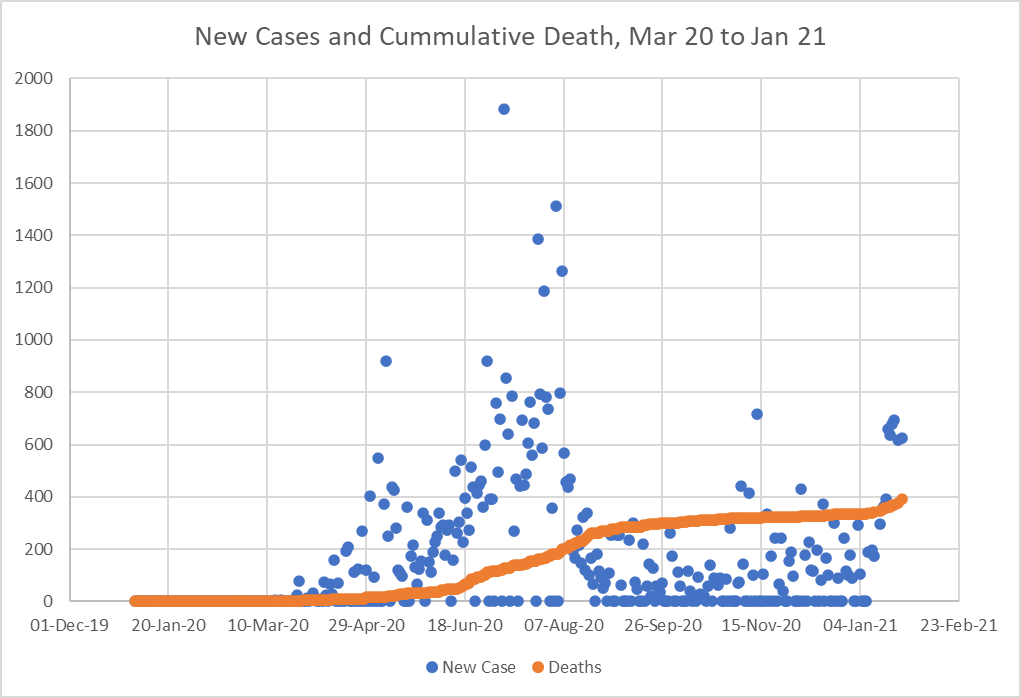
Obviously, it is an undisputable fact that Ghana is experiencing an increase in the COVID-19 cases since the beginning of January 2021 and people may be right in describing it as a second wave looking at what happens elsewhere.
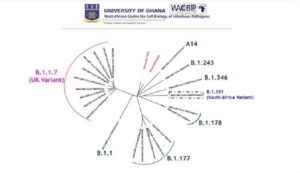
This happened to coincide with the announcement by the President of Ghana of the new strain of SARS COV-2 identified among travelers that had been tested at the airport since a new strain was reported in the UK. The sequencing is an advanced test to the PCR to identify the new strain was carried out by the team of researchers led by Professor Gordon Awandare of the University of Ghana.
For almost a week running, the daily cases recorded in Ghana exceeds 500. Since the new strain of SARS COV-2 identified and described in other countries is known to be about 50% to 70% contagious than the Wuhan strain, many have ascribed the rise in cases to be caused by the new strain. Unfortunately, no data is available to support this claim.
As we wait for the population surveillance promised by the government and those in authority to monitor if the new strain is responsible for the rise in cases, it is important to note that we are nowhere close to what we experienced in July and August 2020 where the peak of the pandemic was recorded.
Though one cannot dispute the possibility of carriers of the new strain entering the country to spread the virus, we need to cause a scare with misinformation. Some fundamental information about the new strain of SARS COV-2 are;
1. the new variant is highly infectious about 50-70% times the Wuhan strain. About 6 described so far but the infectious forms are causing most infections in UK, South Africa, and Brazil respectively.
2. the good news is that the new strain is not known to cause serious illness or deaths than the Wuhan strain. So it is just being contagious and so spreads faster.
3. it has only been described among travelers who came into the country, got tested, and their samples sequenced. No data suggest it is in the population yet
4. currently our testing methods can pick the new strains
5. vaccines available are found to produce antibodies that can inactivate the new strain.
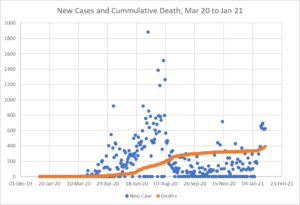
Just as has been described by the WHO, it is important not to cause panic with information that is not backed by data. Ghana recorded more than 37 deaths between 08th January and 26th January 2021, among those who got infected with the SARS COV-2 but that is not enough to suggest that the infections recorded currently are due to the new variant.
Going through transcripts by the WHO suggests that the new variant is only infectious than the mother strain but most of its attributes are similar to the Wuhan strain.
Transcript 1
Vismita Gupta-Smith
Soumya, tell us what we know about these variants. How concerned should we be? And is it unusual for viruses to change?
Dr Soumya Swaminathan
From the beginning of the year, we’ve been tracking this virus and we know that it’s gone through a lot of changes and there’ve been variants before. Now this particular time there have been two particular variants that have been reported to WHO. One was identified in the UK and one was identified in South Africa. They do have one change in common, we call it the N501Y mutation. But otherwise the two are different. And the reason there’s concern is that both of these variants were associated with an increase in the number of cases in both of these countries.
And scientists have now studied this and have found that these variants do tend to spread faster, they’re more transmissible or more infectious. So that’s the worrying part. However, so far, they do not seem to cause more severe illness or a higher death rate or any sort of different clinical manifestations.
They seem to behave pretty much as the previous viruses were behaving and cause a pretty similar kind of disease.
Transcript 2
Vismita Gupta-Smith
We hear a lot about COVID-19 and symptoms in grownups and adults. How does COVID-19 impact children? Welcome to Science in 5. I’m Vismita Gupta-Smith and this is WHO’s conversations in science. We’re talking to Dr. Maria Van Kerkhove today about COVID-19 and children. Welcome, Maria.
Dr. Maria Van Kerkhove
Hi, Vismita. Thanks for having me.
Vismita Gupta-Smith
Maria, tell us about symptoms of COVID-19 in children. Are they any different from grownups, especially in the very young ones?
Dr. Maria Van Kerkhove
So, this is a really important question and we continue to learn about SARS-CoV-2 virus, the virus that causes COVID-19. There are different types of disease presentation based on the age of the person who is infected by this virus. Luckily, children and adolescents tend to have more mild disease compared to adults. Most people who are infected with the SARS-CoV-2 virus have respiratory symptoms. They start to feel a little bit unwell, they will have a fever, they may have a cough or a sore throat or sneeze. In some individuals, they may have gastrointestinal symptoms. Others may lose the sense of smell or the sense of taste. Especially in the youngest children, they tend to be more mild, which means they don’t have as many symptoms as adults do. Some children may have gastrointestinal symptoms like diarrhoea or vomiting, but they tend to be more mild. And even most children tend to have asymptomatic infection, which means they don’t have any symptoms at all.
Vismita Gupta-Smith
Maria, we’re hearing a lot about these variants now; what are we seeing? In children, do these variants have different symptoms? Are they impacting children in a different way?
Dr. Maria Van Kerkhove
So, virus variants mean changes in the virus and we are detecting changes in the SARS-CoV-2 virus over time. This is expected. Many of these changes do not have any impact on the virus in terms of its ability to transmit or the disease that it causes. But some variants we call “variants of concern” and these viruses need more study. And scientists are looking at the way the virus transmits, the disease that it causes, and luckily so far, these variants do not tend to cause more severe disease across any age group. The disease presentation looks the same and the severity looks the same as the other SARS-CoV-2 viruses circulating. In terms of transmission, the virus variant that was identified in the United Kingdom, they noticed an increase in transmissibility across all age groups. This includes increased transmission among younger children as well. In the area where this virus variant was circulating, schools happened to have been open. And the virus that was circulating, also circulated among the students and the faculties in those schools that were open. So, there’s much study that’s still underway with these virus variants, but the studies in the United Kingdom, for example, do not indicate that the virus specifically targets young children, meaning that it’s not infecting children more than would be likely of other viruses that are circulating in the area.
Vismita Gupta-Smith
Maria, we don’t want to worry mothers, fathers, and caregivers. So, give us some tips about how to keep children, especially the little ones, safe.
Dr. Maria Van Kerkhove
The best way to keep children safe is about prevention. We want to prevent as many infections as we possibly can all over the world. And it’s about doing it all. The comprehensive package of interventions that you hear us talk about all the time apply to children as well. Making sure children have clean hands and they wash their hands appropriately with soap and water and sing the songs so that they get enough bubbles and they make sure that those hands are really clean. Or use an alcohol-based rub. Make sure that they practice respiratory etiquette, where they sneeze into their elbow. Even my littlest one who’s two years old now, will cough and sneeze into his elbow. But these are good habits to be forming for children as they get older. Making sure that if they’re age appropriate and they follow the local guidance to wear a mask appropriately. With clean hands, make sure that the mask is put on over your ears, covers their nose and their mouth and that the children don’t touch the outside of their masks. Make sure that they have clean hands. And then when they take it off, to clean their hands as well. Making sure that you as parents talk to your kids as best you can answering their questions. There’s a lot of confusing information out there and it’s scary. So, find the time to talk to them and answer their questions and alleviate their fear, and make sure that they get good information from you. And probably the most important thing that everybody can do is physical distancing. Outside of your immediate family, make sure that you keep your distance from others. That’s the best way to prevent the spread of SARS-CoV-2.
Vismita Gupta-Smith
Thank you, Maria. So, parents remember you have a whole toolkit of precautionary measures; make that part of your daily routine and habit for your children. And, also please share this information and other science-based information with your networks of parents. Until next time then. Stay safe, stay healthy and stick with science.

Secure Amoxicilina Medicine Shipped Ups